
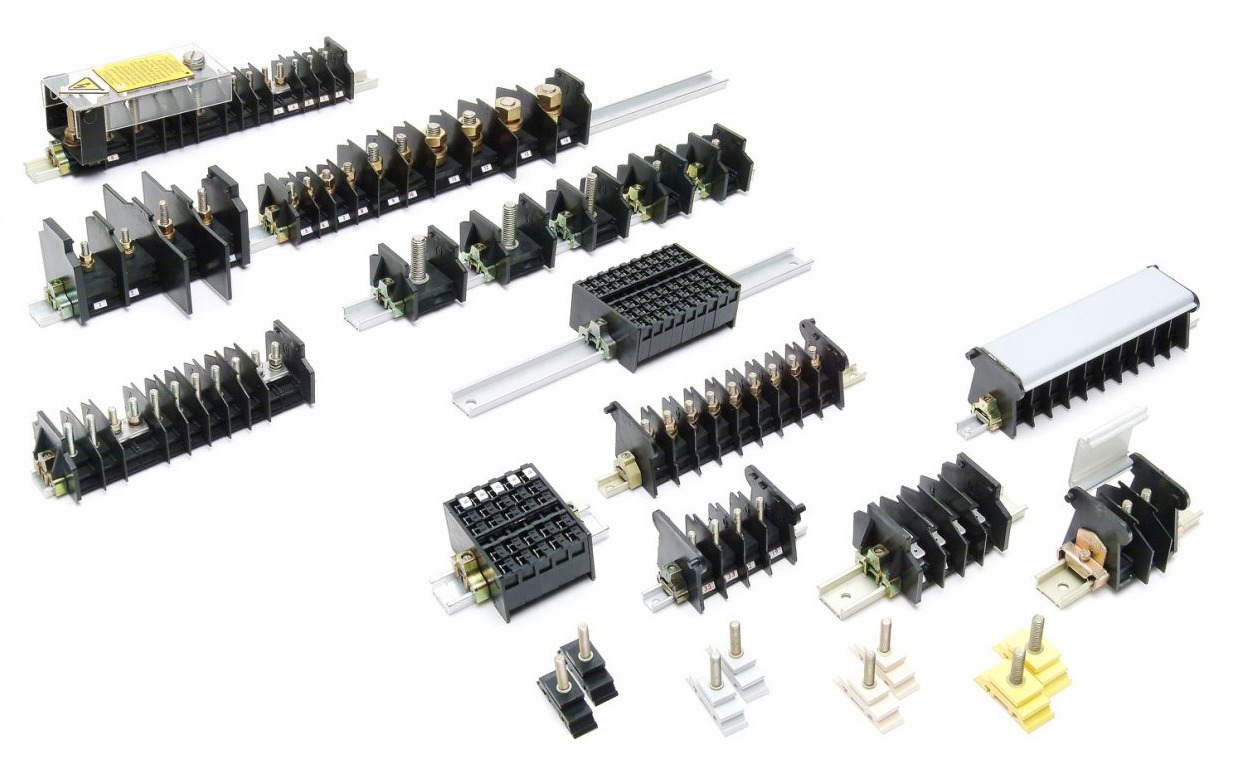
Terminal rails (sometimes supplied as complete “terminal rail assemblies”) are engineered termination points that let you bring multiple conductors to a compact, mechanically secured, clearly identified interface—usually fixed to a panel, frame, or enclosure. In practice they sit between the cable/harness world and the equipment world: harnesses land on the rail, and short internal links (or busbars) route power and signals onward.
In aerospace, rolling stock and defence platforms—where wiring looms are dense, environments are harsh, maintenance access is limited, and documentation/traceability is paramount—terminal rails are a deceptively simple component that solves several recurring cable termination problems at once.
The cable termination problems terminal rails help solve
1) Space, complexity and “wire spaghetti”
High-integrity vehicles often pack a lot of function into small volumes: power distribution, control, comms, sensing, safety loops, redundancy, etc. If every cable had to be landed directly onto PCBs, contactors, relays, or equipment connectors, the result is:
- crowded terminations
- difficult bend radii
- risk of conductor damage from tight dressing
- poor readability during inspection
A terminal rail creates a single, orderly landing zone. You can route looms to one edge of the cabinet/box, terminate once, then distribute internally with shorter, controlled wiring runs.
2) Repeatable, inspectable terminations
Termination quality is one of the most common failure points in mobile/defence systems: loose fasteners, under/over-torqued screws, strands cut during stripping, poor crimping, inadequate strain relief, or mis-identification.
Terminal rails improve repeatability because they:
- standardise the mechanical interface (studs, Faston tabs, screw clamps, push-in/spring clamps, etc.)
- allow proper strain relief and lacing to be applied before the final termination point
- make inspection straightforward (visual access, marking, torque witnessing)
Many terminal rail solutions are offered as compact assemblies with options like studs, Faston terminations, fused terminals, and diode carriers, designed for rapid installation and serviceability in rail, aerospace and defence.
3) Maintenance and fault isolation
When something fails in service, maintainers need to isolate circuits quickly and safely.
A terminal rail makes it easier to:
- probe a circuit without dismantling equipment internals
- isolate subcircuits (by removing a link, fuse, or disconnecting a block depending on the design)
- swap a harness or a unit without rewiring half a cabinet
4) Mixed conductor types and gauges
Real systems often mix:
- heavy-gauge power conductors
- small-gauge control and signal wires
- screened/shielded cables and drain wires
- earth/ground bonding straps
A well-chosen terminal rail architecture can accommodate those differences cleanly—using studs/busbars for power, modular terminals for signals, and dedicated grounding points for shields and bonds.
5) Controlled grounding and EMC bonding
EMC and bonding are critical in all three sectors:
- rail has strong traction/power electronics noise and long cable runs
- aerospace has tight EMC/avionics constraints and weight-driven routing
- defence adds intentional/unintentional RF exposure and rugged operational profiles
Terminal rails can provide a deliberate, documented grounding topology: protective earth (PE), functional earth, shield terminations, and bonding jumpers arranged so you don’t accidentally create noisy ground loops or inconsistent shield connections.
Why these sectors place special demands on terminal rails
Rail (trains)
Rolling stock is exposed to vibration, shock, temperature cycling, moisture, and long service life expectations. Rail standards typically impose requirements for shock and vibration performance, environmental endurance, and fire safety in passenger and equipment spaces.
Practical implication: the termination system must stay mechanically stable, electrically reliable, and compliant for decades, with maintainable access and clear identification.
Aerospace
Aerospace wiring is weight- and volume-sensitive, and must cope with vibration, thermal extremes, and stringent reliability assurance. While many interconnect choices differ (connectors dominate), terminal rails still appear in power distribution and equipment bays where a structured termination interface improves maintainability and testability.
Defence
Defence equipment often operates in particularly harsh handling, transport and field environments. Environmental qualification regimes commonly cover temperature, humidity, shock and vibration.
Practical implication: terminal rails and their mountings must resist loosening, corrosion, and mechanical fatigue, and be serviceable under operational constraints.
Key properties required of terminal rails in these applications
1) Fire safety, low smoke and halogen-free construction
In enclosed spaces (train cars, tunnels, aircraft cabins, shelters, vehicle interiors), smoke and toxic gases are often the biggest life-safety hazards during a fire.
EN 45545 (railway fire protection)
EN 45545-2 sets material requirements based on hazard levels HL1, HL2, HL3 (HL3 being the most demanding) and uses different requirement tables for internal and external applications. It addresses flammability, smoke emission and toxicity performance, with requirements linked to where and how the material or component is used.
For electrical equipment, including termination hardware located inside vehicles, the standard makes clear that non-cable components (such as terminal carriers, separators and covers) may also need to comply.
Some EN 45545-2 testing regimes assess toxicity alongside smoke and flame performance, reflecting the real-world risk posed by decomposition gases in enclosed environments.
BS 6853 (legacy and UK rolling stock use)
BS 6853 is widely associated with UK rolling stock fire performance expectations and includes smoke emission and flammability testing approaches. It introduced the concept of an R-Index as a single-number indicator of performance within its methodology.
Although EN 45545 is now the dominant European framework, BS 6853 is still referenced in many UK specifications and procurement documents.
“Low smoke and halogen free” terminal rail materials
Terminal rails intended for rail, aerospace and defence applications are often specified as low smoke, halogen-free, with explicit claims of conformity to EN 45545 and BS 6853. This reflects the reality that termination hardware is frequently installed inside enclosed passenger, crew or equipment spaces, where fire by-products pose a significant risk. LPA Group’s terminal rails are an example of solutions designed with these material expectations in mind.
2) Mechanical integrity under vibration and shock
A termination that is electrically perfect on day one can fail months later if vibration frets contacts, loosens fasteners, or work-hardens conductors at the termination point.
Across rail and defence applications, shock and vibration requirements drive design features such as:
- locking or captive hardware
- anti-rotation measures
- robust mounting to stiff backplates or frames
- effective strain relief before the termination point
The goal is to ensure long-term stability under continuous vibration and occasional high-shock events.
3) Electrical safety: creepage, clearance and insulation coordination
High-voltage or transient-rich systems (traction auxiliaries, power conversion, military vehicle power) demand correct spacing and insulation performance.
Terminal rails help because they:
- enforce consistent conductor separation
- allow the use of barriers and partitions
- provide a predictable physical layout for design assurance and inspection
Exact creepage and clearance requirements depend on voltage level, pollution degree, altitude and the applicable sector standards, but a structured terminal rail layout makes compliance far easier to demonstrate.
4) Corrosion resistance and long-life contact stability
Rail and defence environments can include humidity, condensation, washdown and temperature swings; aerospace adds altitude and thermal cycling.
Typical expectations include:
- corrosion-resistant plated conductors and hardware
- stable contact surfaces that resist fretting
- materials compatibility to avoid galvanic corrosion
- predictable torque retention over long service periods
5) Identification, traceability and configuration control
These sectors are documentation-heavy for good reason.
Terminal rails support:
- terminal numbering and circuit identification
- clear harness-to-equipment mapping
- controlled design changes without wholesale rewiring
- easier inspection, audit and overhaul activities
How to specify terminal rails for aerospace, rail and defence builds
When writing a specification or RFQ, it’s usually most effective to define requirements at the assembly level, not just for individual terminal blocks:
Fire performance & materials
- Low smoke, halogen-free insulating components
- Explicit EN 45545 hazard level and application context where relevant
- BS 6853 conformance where still mandated by operator or authority requirements
Environmental robustness
- Defined shock and vibration performance aligned to the applicable sector standards
Termination methods
- Stud sizes and torque specifications for power circuits
- Clamp types for control and signal wiring
- Compatibility with ferrules, lugs, ring terminals and Faston tabs
- Provision for shield and earth bonding
Serviceability
- Adequate access for tools and inspection
- Replaceable or modular elements where appropriate
- Test points, fused links or isolation links if required
Bringing it together
Terminal rails act as risk reducers in complex electrical systems. They transform cable termination from a crowded, bespoke and failure-prone activity into a structured, inspectable interface that can be engineered for harsh environments and strict fire-safety regimes.
In rail applications in particular, specifying low smoke, halogen-free terminal rail materials aligned with EN 45545—and often BS 6853—helps ensure that termination hardware does not become a weak link in a fire scenario, where smoke density and toxicity can be as critical as flame spread.