
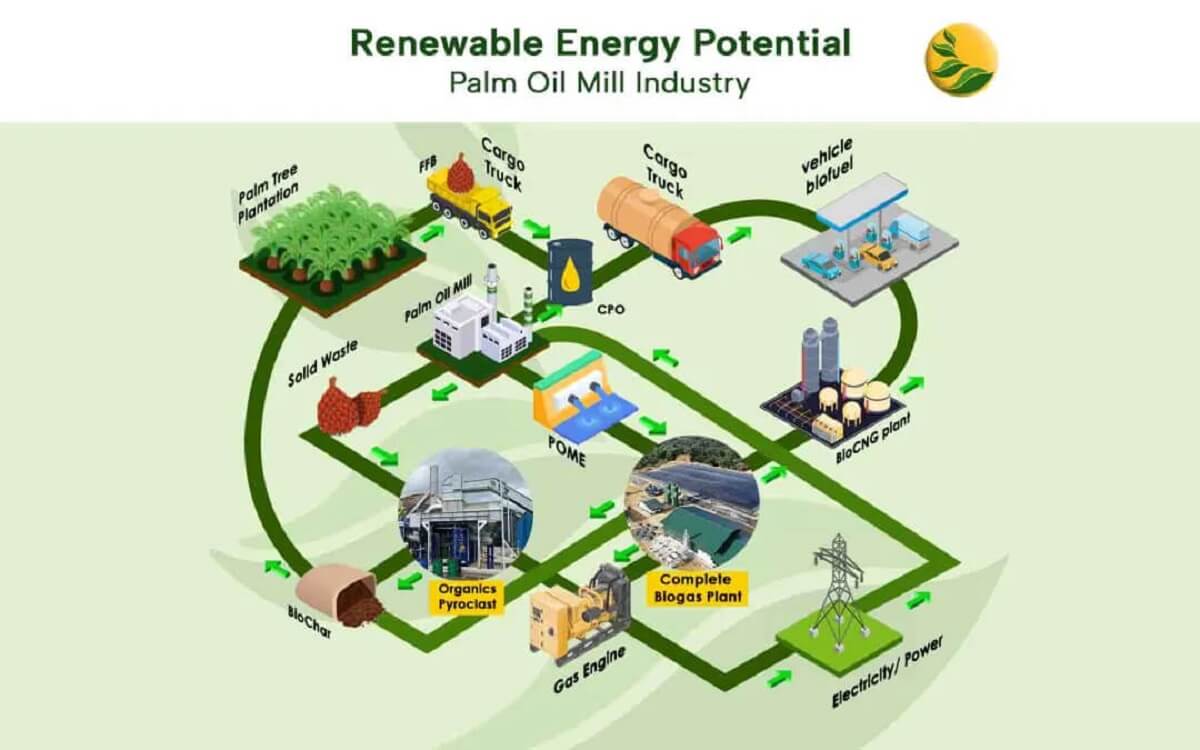
Agricultural waste and smart infrastructure have given rise to an unprecedented innovation in the global race to approach “Net Zero”. For so long, solar streetlights have experienced efficiency issues due to dirt on the solar panels, but they are now being redesigned to do so with principles of a circular economy. Highly experienced researchers now have a sustainable solution to two environmental problems, making use of oil palm waste to create advanced self-cleaning materials.
Why did solar streetlights gradually stop working?
The efficient working of solar energy systems is truly dependent on the amount of sunlight hitting the photovoltaic (PV) cells. In an agricultural area, particularly in the vicinity of an oil palm plantation, there are environmental challenges that solar streetlights face.
- Airborne Oil Particles: Microfin droplets of palm oil are emitted into the air at palm oil processing plants. These particles slowly stick to the glass surface of solar panels, creating a smearing type of layer. These particles gradually adhere to the surface of the solar panel glass, creating a sticky layer.
- Bio-Particulates: In plantation areas, there are also considerable amounts of pollen, plant residue, and organic dust produced. Easily adhere to the oily surface on the panel already.
- “Soiling” Effect: Continuous accumulation can lower down the ability of the streetlights to absorb solar energy by as much as 30% – 40% in just a few weeks in humid tropical climates where such lights are typically used.
Manual cleaning of lights is not at all possible due to the remote locations and extremely large numbers. This has made self cleaning an absolute must-have feature and not an option.
Transforming Waste Into Workable Technology
The introduction of Palm Oil Fuel Ash (POFA) and Palm Kernel Fiber for high-tech coatings is one of the most crucial advances in this area.
The Nano-Silica Process
At the time of the process of controlled combustion and chemical leaching the resulting wastes will naturally have high silica (SiO) content. After controlled burning processes and chemical extraction methods, the researchers are able to extract nano-silica from the ash after burning. The silica found is then chemically treated to make it an extremely water-repellent or superhydrophobic coating.
How can this actually work?
The coating formed from this waste material is applied on the surface of the glass of the street light, causing what scientists term the “Lotus Effect.” Water drops on the surface cannot be spread over it. In contrast, they form a sphere and roll off readily along with the dust, oil residue, and dirt particles. With this, the whole system is working fine.
Deep Insights about Mechanical vs. Chemical Self- Cleaning
These systems are termed “passive” and “active” self-cleaning systems, respectively. While most of the cleaning takes place at the micro level with nano-coatings, many of today’s solar streetlights have two cleaning systems. Let’s unearth the workings of both approaches:
- Active Cleaning: Technology advancement through automated wipers that are powered by the street light’s battery system. The robotic solar panel cleaning is activated during precipitation or as set for a specific time to eliminate hard-to-remove debris on the surface.
- Passive Cleaning: The superhydrophobic coating and nano-coating reduce the capacity of dust and dirt to stick well to the surface of the panel.
This combination of the two methods will help to greatly increase cleaning efficiency and minimize maintenance requirements.
What are the advantages of oil palm waste?
Making use of oil palm waste for sustained renewable energy systems is a great example of a closed loop sustainable system.
- Utilization of Waste: Millions of tons of agricultural biomass produced from the oil palm industry would be discarded, burnt or dumped in landfills, if it were not for the oil palm industry. By this innovation, waste is converted into valuable nanotechnology materials.
- Lower Manufacturing Costs: The most common self-cleaning coatings are often based on costly synthetic chemicals and fluorinated compounds. Using POFA as a raw material to obtain Nano-silica is one of the best and cost-effective bulk production methods.
- Longer Infrastructure Lifespan: Cleaner solar panels also reduce the chance of the development of “hot spots” that are overheated areas that result from dirt build-up on the panel. There are chances that these hot spots may cause permanent damage to the solar cells and shorten the life of solar street lights.
Read Also: A Complete Guide to Oracle Cloud ERP Excellence
Introduction to the Global Market
Southeast Asian and African countries offer an abundant source of raw materials needed for these coatings, but the United States and European countries are the primary drivers of the development of IoT integration to be embedded in modern street lighting.
There are now many solar lighting systems which are self-cleaning with technologies like LoRaWAN and 4G connectivity. Plantation owners and city managers can use these systems to track each battery’s performance, cleanliness of the panels, and the efficiency of battery usage and other operations, via centralized digital platforms, from thousands of street lights across a city.
Conclusion
To sum up, technologies are required to ensure the efficient operation of these systems under extreme environmental conditions. Researchers are now identifying new uses for oil palm waste to build solar-powered streetlights that will be safeguarded by the use of sustainable materials. The solar streetlights that clean themselves are telling their story about how the smart city infrastructure is going to be more sustainable, intelligent and reliable in the coming future. It is a significant step towards a more eco-friendly and sustainable way of illuminating our whole world, portraying the power of environmental responsibility, renewable energy, and intelligent engineering