


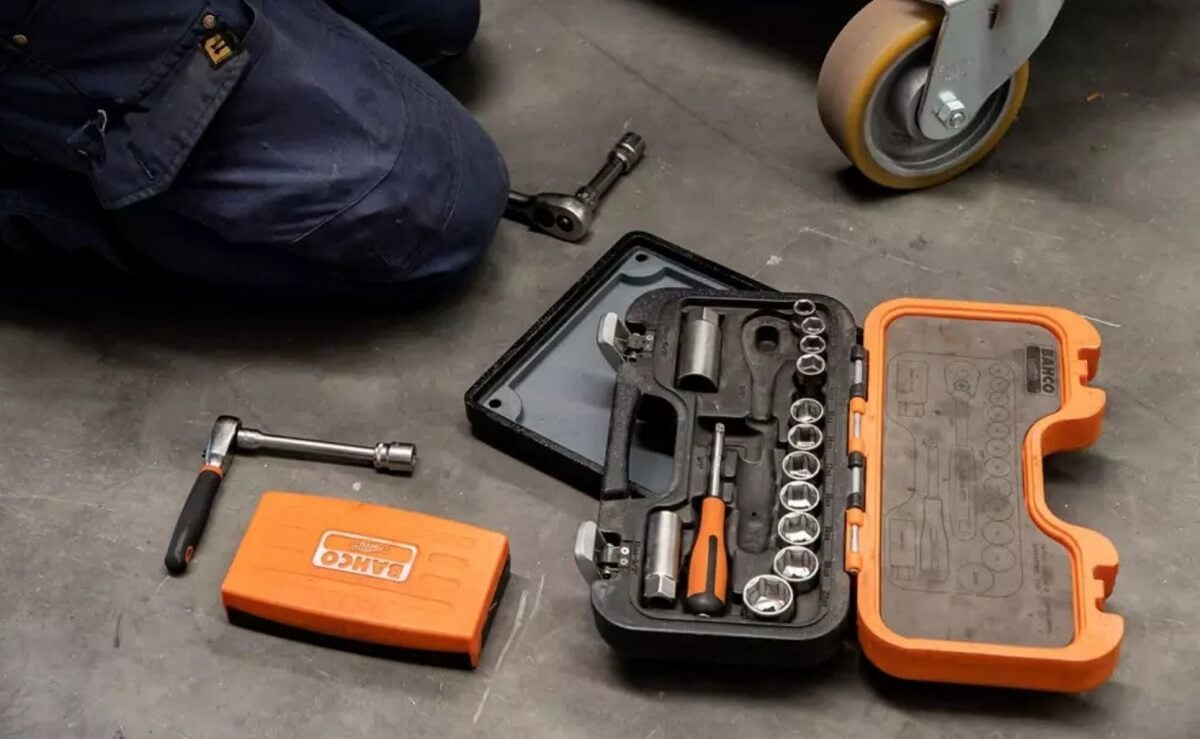
Few tool brands can trace their lineage back to the Bessemer steel revolution of the nineteenth century, but Bahco can. Behind that small fish-and-hook logo stamped on millions of wrenches, pliers, saws and screwdrivers sits one of the oldest continuously operating tool brands in the world — a company whose story runs through Swedish industrial history, several mergers and acquisitions, and more than 400 patents. This article traces how Bahco went from a single inventor’s workshop to a global professional tool brand, looks at the sheer breadth of what it makes today, and explains why so many trades and industries reach for Bahco over the competition.
Origins: Steel, Saw Blades and a Very Clever Wrench
Bahco’s roots actually begin with steel rather than tools. In 1862, Swedish industrialist Göran Fredrik Göransson founded Högbo Stål & Jernwerks AB in Sandviken, having become the first person in the world to successfully apply the Bessemer process for mass-producing high-quality steel at industrial scale. That company would later be reorganised as Sandvikens Jernverks AB, and eventually become Sandvik — a name that reappears throughout Bahco’s history. In 1886, using that same high-grade steel, the company began producing saw blades under the now-famous “Fish & Hook” trademark, chosen specifically because it symbolised the strength and flexibility needed in a good blade — hard and durable, yet not brittle.
At almost the same moment, in a separate workshop in Enköping, Sweden, an inventor named Johan Petter Johansson — known simply as “JP” — was building a company called Enköpings Mekaniska Verkstad. JP was a prolific inventor credited with close to 100 patents over his lifetime, but two stand out as genuinely transformative: the pipe wrench, patented in 1888, and the adjustable spanner (what most of the world now calls an adjustable wrench), patented in 1891 and 1892. The adjustable wrench in particular became one of the most widely copied and universally recognised hand tools ever created, and its basic mechanism — a smooth-adjusting worm screw moving a sliding jaw — remains essentially unchanged in principle to this day.
In 1889, Stockholm businessman Berndt August Hjorth opened a tools and machinery trading company, B.A. Hjorth & Co. The following year, Hjorth’s company acquired the sales and marketing rights to JP’s inventions and began distributing them worldwide under a new trademark: Bahco, an abbreviation of the company’s name. It was this distribution and branding arrangement — rather than a single founding moment — that effectively created Bahco as the world would come to know it.
Consolidation Under Sandvik
Through the early and mid-twentieth century, Bahco grew through a familiar pattern of Swedish industrial consolidation, expanding sales through trading houses across Scandinavia, the UK, Germany, Russia and France, and opening its first overseas sales subsidiary in the UK in 1914. The steelworks founded by Göransson in the 1860s eventually became Sandvik AB in 1972, and by the late twentieth century, the various strands of Sweden’s steel and tool-making heritage — the original Sandviken steelworks, JP’s tool designs, and the Bahco trading and distribution network — had become intertwined under Sandvik’s ownership. Bahco Tools became part of Sandvik’s Saws & Tools business area, benefiting from major investment in production efficiency and a modernised global distribution network.
A New Owner: The Snap-on Era
The most significant ownership change in Bahco’s modern history came at the close of the twentieth century. In the mid-1990s, American tool giant Snap-on Incorporated entered the European market by acquiring the Spanish hand tool manufacturer Herramientas Eurotools S.A. Then, in 1999, Snap-on acquired Sandvik’s entire Saws & Tools business area — some 2,500 employees — forming a new entity called Bahco Group AB.
In 2005, Bahco AB and Eurotools formally merged to create SNA Europe, with Bahco established as the group’s flagship, premium brand. Today SNA Europe also owns Lindström (a precision tool brand founded in Eskilstuna, Sweden, with a heritage almost as long as Bahco’s own) and Irimo, a Spanish tool manufacturer, giving the group a combined portfolio built on well over 170 years of accumulated tool-making experience. SNA Europe now operates around ten to eleven production facilities and multiple logistics centres worldwide, with a large share of Bahco’s product range still manufactured in its traditional European heartlands, including dedicated factories such as the one in Baugé-en-Anjou, France, which specialises in pruning tools, and long-established Swedish sites producing saw blades.
Innovation as a Constant Thread
What’s notable across Bahco’s 130-plus-year history is how consistently the brand has pushed hand tool design forward rather than simply manufacturing to an existing standard. Some of the landmark moments include:
- 1888–1892 — JP Johansson’s pipe wrench and adjustable wrench patents, arguably the foundation of the entire Bahco brand.
- 1969 — Introduction of the Sandflex bi-metal hacksaw blade, combining a hard, wear-resistant cutting edge with a flexible steel backing, which became (and remains) an industry-standard approach to hacksaw blade construction.
- 1982 — Bahco introduces what it describes as the world’s first ergonomically designed screwdriver, reflecting an early and unusually strong focus on hand-tool ergonomics well before “ergonomics” became a mainstream engineering consideration.
- The ERGO™ range — a broad, ongoing ergonomic design programme covering pliers, wrenches, screwdrivers and more, engineered around hand anatomy and grip biomechanics to reduce strain and injury risk during repetitive professional use. The ERGO Ratchet has been recognised with a Red Dot Design Award, one of the most respected international product design accolades.
- 1996 — Patenting of the “Superior” handsaw design.
- More recent developments — the Bahco Connect App, which added Bluetooth connectivity to torque tools, allowing technicians to programme torque settings, capture measurement data and maintain digital traceability records directly from a mobile device, reflecting Bahco’s push into connected and data-traceable tooling for regulated industrial environments.
Across its history, SNA Europe states that Bahco and its associated brands have registered more than 400 patents — a substantial figure for a company operating in a product category (hand tools) that many assume changed little over the past century.
The Modern Bahco Range: Breadth Across the Trades
If Bahco built its reputation on the adjustable wrench and the saw blade, its modern catalogue is vastly broader. Depending on the source and market, the current Bahco tools range spans anywhere from roughly 7,000 to more than 20,000 individual product lines, covering:
- Wrenches and spanners — adjustable wrenches, combination spanners, pipe wrenches, and specialist automotive spanners.
- Sockets, ratchets and accessories — including precision and torque-controlled variants for regulated assembly work.
- Pliers and cutters — combination pliers, snips, and fine electronics pliers for delicate assembly and repair work.
- Screwdrivers and bits — including the ergonomic ranges Bahco is particularly known for.
- Hand saws and metal-cutting saws — hacksaws, handsaws and specialist blades, drawing directly on the company’s original steelmaking heritage.
- Files and rotary burrs — for precision metal finishing and deburring.
- Torque tools — click, dial and now digitally connected torque wrenches for applications where fastener tightness must be precisely controlled and, increasingly, digitally recorded.
- Automotive specialist tools — designed for specific vehicle maintenance and diagnostic tasks.
- Refrigeration and HVAC tools.
- Tool storage systems — trolleys, foam-profiled drawer inlays and portable cases designed to make missing tools immediately obvious, an important safety feature in industries where a lost tool left inside equipment can cause serious damage or danger.
- Non-sparking (NS) tool ranges — tools made from special alloys rather than standard tool steel, designed for use around flammable gases, vapours or dust in petrochemical, mining and similar environments where a stray spark could trigger an explosion.
- Pruning and forestry/garden tools — secateurs, loppers and, increasingly, cordless electric pruning equipment for professional horticulture, vineyards and orchards, an area Bahco has invested in heavily and where it has picked up recent Red Dot and iF Design awards.
This diversity reflects a deliberate strategic shift over recent decades: rather than being purely a general mechanic’s or tradesperson’s brand, Bahco increasingly positions itself around solving specific problems for specific demanding professions, from aerospace assembly lines to vineyard pruning crews.
The Tools Bahco Is Best Known For
A handful of Bahco products have achieved something close to icon status within their categories:
- The adjustable wrench — still often referred to informally as a “Bahco” in parts of Europe, in much the same way a vacuum cleaner might be called a “Hoover,” a strong indicator of just how thoroughly the original 1892 design shaped the category.
- The Sandflex bi-metal hacksaw blade — widely regarded as a benchmark product in the hacksaw blade market since its 1969 introduction, still manufactured and sold today.
- ERGO pliers and screwdrivers — a go-to reference point in discussions of hand tool ergonomics, frequently cited in occupational health and ergonomics literature.
- Combination pliers and cutters — everyday staples on tool trucks and in trade toolboxes across Europe.
- Non-sparking tool sets — a specialist but critical product line for oil and gas, petrochemical and mining operations, where a conventional steel tool could pose a genuine explosion risk.
Which Industries Choose Bahco, and Why
Bahco markets itself explicitly toward what it calls “the most demanding professionals,” and the industries that most consistently choose the brand over cheaper alternatives tend to share a few characteristics: high consequences for tool failure, strict safety or traceability requirements, and heavy day-to-day tool use where durability and ergonomics genuinely affect productivity and injury rates.
Aerospace and automotive manufacturing. Precision, repeatability and traceability matter enormously on an assembly line, and Bahco’s torque tool range — increasingly with digital, Bluetooth-connected programming and data logging — appeals directly to manufacturers who need documented proof that fasteners were tightened to exact specification. Foreign object debris (FOD) prevention is also a serious concern in aerospace settings, which is part of why Bahco’s structured tool storage and shadow-boarding systems, designed to make a missing tool immediately obvious, are valued in that sector.
Oil, gas, petrochemical and mining. These industries operate in environments where flammable vapours or dust make conventional steel tools genuinely dangerous, which is exactly what Bahco’s non-sparking tool range is built for. Bahco is also a member of DROPS, an industry-wide initiative focused on preventing dropped objects on rigs, platforms and elevated worksites, and its tool ranges are designed and approved with DROPS practices in mind — an important consideration in an industry where a dropped tool from height can be fatal.
Marine, shipping and power generation. Similar logic applies here: harsh operating environments, high stakes for equipment failure, and a premium on tool durability and corrosion resistance.
Construction and trades. Everyday trade professionals — electricians, plumbers, HVAC technicians, general tradespeople — are drawn to Bahco largely for the combination of durability and ergonomics. Tools that are used dozens or hundreds of times a day need to minimise hand and wrist strain, and Bahco’s decades-long investment in ergonomic design (arguably starting with that 1982 ergonomic screwdriver) is a genuine differentiator against cheaper, less carefully engineered competitors.
Forestry, horticulture and agriculture. Bahco’s pruning and forestry tool range — secateurs, loppers, hand saws and increasingly cordless electric pruning tools — has become a significant business line in its own right, particularly in European vineyards, orchards and commercial landscaping, where tool weight, cutting geometry and repetitive-use comfort directly affect a worker’s daily productivity and long-term joint health.
General industrial and metalworking. The brand’s original strength — high-quality steel — still underpins its file, saw blade and cutting tool ranges, which remain a reference point for metal fabrication and workshop environments.
Across all of these sectors, the common thread in why professionals choose Bahco over lower-cost alternatives tends to come down to three things: confidence that the tool will perform reliably under demanding or safety-critical conditions, a design philosophy that treats ergonomics as central rather than an afterthought, and a very long track record — a brand that has been solving trade problems since the 1880s carries a certain institutional trust that newer entrants simply haven’t had the time to build.
A Brand Still Evolving
What’s striking about Bahco’s history is how little it has stood still. A company that began by combining Bessemer steel with a Swedish inventor’s wrench design has, over more than a century, absorbed multiple mergers, changed hands between Swedish and American industrial giants, and expanded from a handful of core products into a catalogue running into the tens of thousands of items. Its recent moves into connected, data-logging torque tools and cordless power equipment for pruning and forestry suggest the same pattern of steady, practical innovation that built the brand in the first place — adapting genuinely useful new technology to old, well-understood trade problems, rather than chasing novelty for its own sake.

